Book Review: Ninth House

I am a daughter of Lethe, and the wolves are at the door.

I had seen Ninth House by Leigh Bardugo around bookstagram, but I hadn’t paid it much attention. Until someone mentioned magic. Magic is my catnip. How had I missed this?! I had been living under a rock, apparently.

I hopped over to libro.fm and added it to my cart. I have credits built up for just this kind of impulsive download. Ninth House did not disappoint. It is, in fact, one of the best fantasy novels I’ve read in a very long time.* It’s gritty. It’s honest. It’s driven by a raw, rough, and dirty kind of magic–where stock market predictions are divined through human intestines and magical drugs can force compliance–without limits.

Alex Stern, the story’s protagonist, is plucked from the shady underbelly of Los Angeles and dropped into Yale’s world of privilege and power. She is recruited by Lethe, the “Ninth House” that oversees the other eight “Houses of the Veil,” the secret societies of Yale, each endowed with its own unique kind of magic. But Alex is not typical Lethe material. She’s different. She isn’t accomplished or academic. She’s a high school drop out, a recovering drug addict, and a victim. But she’s also a survivor. Oh, and she can see ghosts.

Alex works hard to settle into her new life at Yale, under the supervision of Darlington, her guide in this new world of the occult. But one night, he disappears, and Alex is left alone, with an incomplete understanding of the magic she’s supposed to be shepherding. Then a murder rocks the town of New Haven, and she is drawn into the mystery–which will take her to dark and dangerous places, drawn in by insidious forces she can’t begin to understand.

Ninth House is not an easy book to read. The writing is atmospheric, and the system of magic compelling, but the violence throughout the narrative is pervasive and intense. I found myself sucked in by the story, but if I paused to visualize what was happening (or had happened), the actual violence of the events was horrific. It’s a difficult, heavy read. Additionally, this is not a fast-paced book. There’s a lot of meandering, and the narrative is set up as a series of flash-backs and flash-forwards–between the fall semester and the spring semester, before Darlington disappears, and after.

There are periods of intense action; there are lulls. And there is necessarily quite a bit of exposition about the unique magics involved and Alex’s personal history. Setting up a new world can take quite a bit of time and effort, even a world grounded in our own, and I can’t wait to see how the series evolves over time.

Personally, I loved how Bardugo tied together all these small details together to create such a complete picture of Alex and her character. She isn’t naturally strong, brave, or loyal. She’s a survivor, yes, but she’s been irrevocably changed by what she’s experienced. She’s been damaged, broken, and abandoned, and she can’t just emerge from all of that without scars. I think that’s what I liked most about her. Her scars, her doubts, her skepticism and insecurities–those are the things that make her human, and her growth from the beginning to the end reveals the tenacity of her spirit.

Bottom line: I thought it was utterly fascinating. I loved it. This was my first exposure to Leigh Bardugo, but I’d say her transition from YA to adult fantasy was a roaring success.

I am aware, however, Ninth House isn’t the book for everyone. Be sure to check out the entire catalogue of trigger warnings at the end of this post because there are multiple issues in the book that could be problematic depending on the reader.

TW: rape (of a minor), sexual assault, suicide, drug use, overdose, murder, intense violence, mutilation, PTSD, gore, possession. (This would definitely be rated “R” if it were a movie. And they’d have to cut parts of it to achieve an “R.”)

*Obviously I’m making a distinction here between fantasy and high fantasy. Throne of Glass 4eva!

SYNOPSIS: Galaxy “Alex” Stern is the most unlikely member of Yale’s freshman class. Raised in the Los Angeles hinterlands by a hippie mom, Alex dropped out of school early and into a world of shady drug dealer boyfriends, dead-end jobs, and much, much worse. By age twenty, in fact, she is the sole survivor of a horrific, unsolved multiple homicide. Some might say she’s thrown her life away. But at her hospital bed, Alex is offered a second chance: to attend one of the world’s most elite universities on a full ride. What’s the catch, and why her?

Still searching for answers to this herself, Alex arrives in New Haven tasked by her mysterious benefactors with monitoring the activities of Yale’s secret societies. These eight windowless “tombs’ are well-known to be haunts of the future rich and powerful, from high-ranking politicos to Wall Street and Hollywood’s biggest players. But their occult activities are revealed to be more sinister and more extraordinary than any paranoid imagination might conceive.

Book Review: Twice In A Blue Moon

As soon as Christina (&) Lauren announce an upcoming book, I preorder it faster than you can say “oohhemmgeeeee.” After laughing my way through The Unhoneymooners, I was counting down the days until their next book hit the shelves. October 22nd couldn’t get here soon enough.

Twice In A Blue Moon arrived on my porch last Thursday morning, and I finished it before I went to bed that night. While it didn’t immediately hook me like The Unhoneymooners or Roomies (or Josh and Hazel), it was ultimately a sweet, slower-paced (moderately steamy) romance from one of my favorite writing duos.

It had a definite YA vibe at the beginning, as a young Tate and Sam meet and fall instantly in love during a vacation in London. Love at first sight has to be done right to work, and CLo did it right. (The YA feel has been the biggest complaint I’ve seen about it on bookstagram, but as a lover of YA, this didn’t bother me at all.) After a devastating betrayal, the story jumps forward in time 14 years, and this sweet second-chance romance is a slow-burn to a satisfying conclusion.

Where The Unhoneymooners was hysterically funny, Twice In A Blue Moon is warmer and more tender. It’s not laugh-out-loud; it’s quiet with a warm cup of tea. As much as Tate and Sam’s love had me crossing my fingers and grinning, it was the love story between Sam’s grandparents that had me wiping my eyes. It was Roberta and Luther’s love that was the heart of the story and guided Tate and Sam to their own happy ending.

Twice in a Blue Moon is beautifully written, crafted with a nuanced tenderness. While it wasn’t the romantic comedy I expected, it was compelling in its exploration of love and what it can overcome. Can someone possibly do the wrong thing for the right reason? Can a once in a lifetime love happen twice?

A portion of the book is written as a screenplay, a story within a story. Because of this, I feel like this book would work really well, possibly even better, as a movie. I’d go see it in a heartbeat.

 ⭐️⭐️⭐️⭐️!!

Also, many thanks to Libro.fm and Simon and Schuster audio for the free ALC of the Twice in a Blue Moon audiobook!

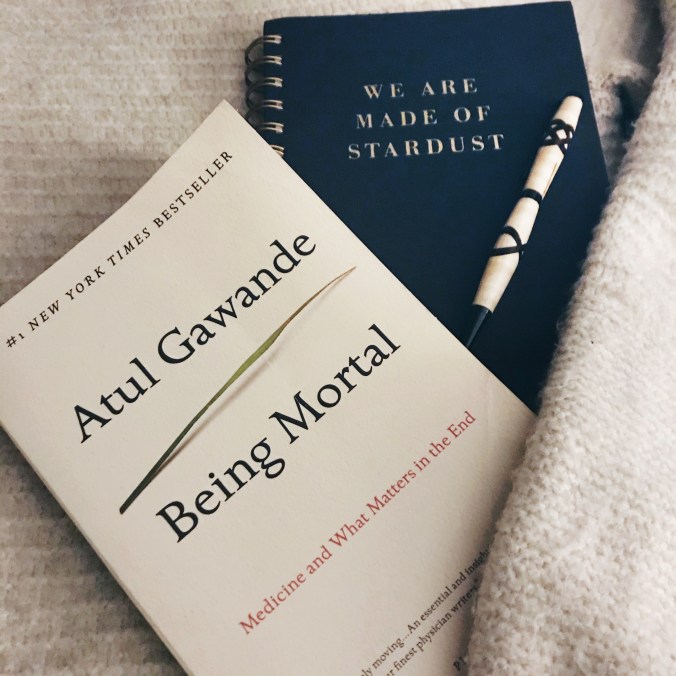
Review: Being Mortal

For human beings, life is meaningful because it is a story. A story has a sense of a whole, and its arc is determined by the significant moments, the ones where something happens…and in stories, endings matter. (p. 238)

Being Mortal by Atul Gawande is perhaps one of the most meaningful books I have read this year. At the beginning of 2019, I resolved to read more non-fiction books, and when this title was suggested as one of our book club selections this month, I knew it was one I needed to read. In fact, I think everyone needs to read it.

In Being Mortal, Gawande presents us with a problem. Death and dying are realities we will all eventually confront. Someone we love will die, and we will, as well. But in the age of modern medicine, with the focus being on saving and prolonging life, medical professionals are struggling with how to treat patients in the final stages of life–the elderly, the frail, the terminally ill, the dying.

Our most cruel failure in how we treat the sick and the aged is the failure to recognize that they have priorities beyond merely being safe and living longer; that the chance to shape one’s story is essential to sustaining meaning in life; that we have the opportunity to refashion our institutions, our culture, and our conversations in ways that transform the possibilities for the last chapters of everyone’s lives. (p. 243)

While I was reading this book, my elderly grandmother–who is in a wheelchair and is almost completely deaf–suffered a stroke and has gone from living (relatively) independently in her assisted living apartment to a hospital bed. Her prognosis is good–she will most likely, with physical therapy, regain her ability to live on her own–but it made the information and the wisdom in the pages of this book feel immediately personal.

My other grandmother, who passed away almost two years ago, lived with dementia for years before she succumbed to a massive stroke. She spent a week, unconscious, in hospice care as her body slowly shut down. I watched her quick decline and have spent the intervening months ruminating on some of the last words she spoke before losing the ability to speak–“not afraid.” She had been afraid of losing her mind, but she was not afraid of death.

The entire concept of “old age” has changed dramatically in the last several centuries. Life expectancy has increased over time as living conditions have improved and medicine has found ways to overcome illness and disease. And the manner of death is largely changed, as well. Before, it was very common for an otherwise healthy person to get sick and very quickly decline and die, all within a few days. Now, with life-saving measures and intensive care units, the process of dying can take weeks or months. And one has to wonder, is that really best for the one who is dying?

In relating life to a story, Gawande highlights that, just like in stories, the end of life matters. Endings matter. They matters tremendously–both to the person who is dying and to those they leave behind.

Our ultimate goal, after all, is not a good death, but a good life to the very end. (p. 245)

If you genuinely desire to understand, as the subtitle says, “medicine and what matters in the end,” this book is essential reading. I’m very much looking forward of our book club discussion next week.

Four Friday Favourites

(Because who doesn’t love a good British spelling.)

Lately I’ve found myself in a bit of a book-slump. I just haven’t had as much time to read, and when I do, the books I pick up just don’t hold my interest, so I’ve been book-hopping. Over on Instagram, I posted a slump-induced stack of four of my favourite books.

Outlander. Throne of Glass. The Unhoneymooners. Circe.

To be honest, I have so many “favourites” that it borders on ridiculous. But that’s what happens when you read more than a hundred books a year, and have been reading voraciously since age three.

There are just so many wonderful books.

Outlander by Diana Gabaldon is one of those books I wish I could read again for the very first time. It’s a perfect blend of romance and historical fiction, and I ate it up. Claire and Jamie’s love story is just so timeless. The length of the individual books can feel daunting, and they are not for the faint of heart, but these characters are friends I will cherish forever. The audiobooks are also fantastic. The narrator, Davina Porter, is just remarkable. (TW: rape, assault, violence)

Throne of Glass by Sarah J. Maas is a relatively recent addition to my bookshelf, thanks to a recommendation from my friend Autumn. I blew through the entire series in the spring and have already reread them. What’s not to love? Assassins. Magic. An ancient enemy. It’s fantasy at its finest. (And I know at the beginning seven books can feel like a huge commitment, but something just clicks halfway through book three, the story takes off, and it’s an effortless race to the finish.) (TW: violence, assault)

The Unhoneymooners by Christina Lauren is hysterical. Laugh out loud funny. Olive and Ethan stole my heart. Then again, I love pretty much every book CLo has written. They were my first “auto-buy” authors, and I will continue to buy anything they publish. Ever. With each new release, my copy makes the rounds through my bookclub gals. I am not alone in my fan-girling.

Circe, by Madeline Miller. Oh Circe. She took me by surprise. Having historically not been a huge fan of mythology, I took a chance on this Book on the Month last year, and I’m glad I did. Miller takes the witch from Greek mythology, a mere footnote in The Odyssey, and transforms her into a woman of strength and resilience. She’s a sympathetic protagonist–tragic but not a victim. Her story moved me to tears, and I walked away from the book wishing she were real. (TW: rape/sexual abuse)

I can’t guarantee a “favourites” post every Friday (because life), but I think it would be a fun series to continue as time and life allows.

What are some of your favorite books?Which book do you return to again and again?

I finally read THE vampire book.

In honor of Halloween (admittedly not my favorite holiday), I sat down with Dracula, a deliciously dark tale of vampires and those who slay them. [maniacal laugh]  It was definitely a different type of book than most of what I’ve been reading this year. Published in 1897, it’s an epistolary novel written entirely as a series of letters, journal entries, ship logs, and newspaper clippings. Its slower pace fit well with the gradually building suspense. It’s definitely old-school gothic horror.

I am a sucker (ha, an accidental pun!) for vampire novels, and have read everything from Anne Rice’s Interview with a Vampire to Twilight, A Discovery of Witches to the Anita Blake and True Blood series. To my horror, however, I realized I’d never read the ultimate vampire book–Dracula.

If you’re used to the sparkly breed of vampire, you won’t find that here. In Dracula, Bram Stoker creates this mythical, monstrous creature–a pale man with red eyes and an evil aspect, who can control animals and the weather, change into a bat or even mist at will, who sleeps in a coffin during the day, and wrecks havoc on the warm-blooded at night. He cannot enter without an invitation and can be repelled by sacred items and garlic. A stake through the heart and a quick decapitation spells his doom.

If you ever wondered where many of our vampiric conventions come from, here’s your answer. Dracula is a classic for a reason. And Stoker actually spent years researching this book, combing through legends and folklore of eastern Europe to piece together the picture we have today of the vampire. And of course, he also introduces another archetype–the vampire hunter–with his memorable and passionate Dr. Van Helsing.

It really makes one consider the implications of immortality and the lengths people will go to prolong their lives. In the case of a vampire, immortality comes at the cost of countless other lives. (No vegetarian vampires here.) Dracula’s motivations are selfish and diabolical. When one lives for centuries, I suppose one would become the most important person in one’s world.

Mina Harker, one of the main characters, is faced with the possibility of becoming one of the undead, and her reaction is completely opposite to that of many in the thrall of a vampire. She does not desire immortality or to become like Dracula. She would willingly die to save others. In fact, she demands that her husband be prepared to kill her, should she turn completely.

Anyway, if you want to go totally crazy, you can go down the literary criticism rabbit hole and find all kinds of crazy theories and interpretations. It’s amusing, but mama ain’t got time for that today. I’m not an English major writing papers for my literary criticism class anymore. (But man, deconstruction was a fun one.)

I’m in the middle of about four books right now of various genres, but I’d really like to read The Haunting of Hill House before October ends because this is basically the only month I bother to read scary books. (I’m a wimp.)

What are some of your favorite scary or creepy reads? I’ll make a list (for next October). (Ha.)


So I’m apparently bad at this.

Blogging  has always been something I’ve wanted to do, and I’ve started several different blogs over the years. There was my angsty college blog peppered with bad poetry and lots of feelings; then there was the blog I started as a first-time mom…which I quickly realized I didn’t have time for. Next was the blog that started out strong–but petered out after nine posts. I wanted to talk about the things that mattered most to me–faith, books, family, homeschooling; it was an experiment in vulnerability. Unfortunately, with three kids six and under, I was naïve in thinking my blog would remain a priority–but it was a good exercise in putting my thoughts down on (digital) paper.

And now there’s this one. My book blog. I posted once. Five months ago.

I would be ashamed if it weren’t so funny.

But never fear, my two faithful followers. I am not giving up.

My life is finally settling into a routine. We’re mostly unpacked at our new house, we’re six weeks into our homeschool semester, and I am being more intentional about carving out time for my own personal creativity, reading, and (you guessed it) blogging.

So buckle up, buttercups.

My next post–anticipated in February of next year.

Just kidding.

maybe.