For human beings, life is meaningful because it is a story. A story has a sense of a whole, and its arc is determined by the significant moments, the ones where something happens…and in stories, endings matter. (p. 238)
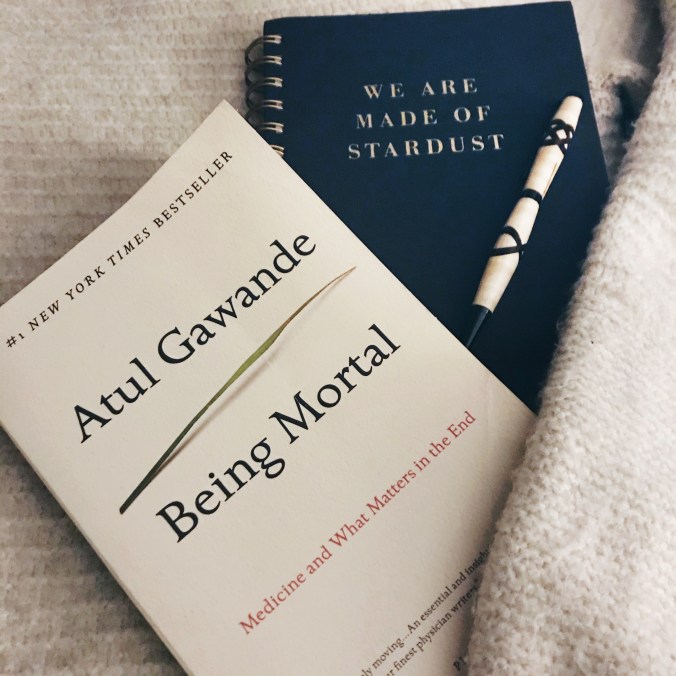
Being Mortal by Atul Gawande is perhaps one of the most meaningful books I have read this year. At the beginning of 2019, I resolved to read more non-fiction books, and when this title was suggested as one of our book club selections this month, I knew it was one I needed to read. In fact, I think everyone needs to read it.
In Being Mortal, Gawande presents us with a problem. Death and dying are realities we will all eventually confront. Someone we love will die, and we will, as well. But in the age of modern medicine, with the focus being on saving and prolonging life, medical professionals are struggling with how to treat patients in the final stages of life–the elderly, the frail, the terminally ill, the dying.
Our most cruel failure in how we treat the sick and the aged is the failure to recognize that they have priorities beyond merely being safe and living longer; that the chance to shape one’s story is essential to sustaining meaning in life; that we have the opportunity to refashion our institutions, our culture, and our conversations in ways that transform the possibilities for the last chapters of everyone’s lives. (p. 243)
While I was reading this book, my elderly grandmother–who is in a wheelchair and is almost completely deaf–suffered a stroke and has gone from living (relatively) independently in her assisted living apartment to a hospital bed. Her prognosis is good–she will most likely, with physical therapy, regain her ability to live on her own–but it made the information and the wisdom in the pages of this book feel immediately personal.
My other grandmother, who passed away almost two years ago, lived with dementia for years before she succumbed to a massive stroke. She spent a week, unconscious, in hospice care as her body slowly shut down. I watched her quick decline and have spent the intervening months ruminating on some of the last words she spoke before losing the ability to speak–“not afraid.” She had been afraid of losing her mind, but she was not afraid of death.
The entire concept of “old age” has changed dramatically in the last several centuries. Life expectancy has increased over time as living conditions have improved and medicine has found ways to overcome illness and disease. And the manner of death is largely changed, as well. Before, it was very common for an otherwise healthy person to get sick and very quickly decline and die, all within a few days. Now, with life-saving measures and intensive care units, the process of dying can take weeks or months. And one has to wonder, is that really best for the one who is dying?
In relating life to a story, Gawande highlights that, just like in stories, the end of life matters. Endings matter. They matters tremendously–both to the person who is dying and to those they leave behind.
Our ultimate goal, after all, is not a good death, but a good life to the very end. (p. 245)
If you genuinely desire to understand, as the subtitle says, “medicine and what matters in the end,” this book is essential reading. I’m very much looking forward of our book club discussion next week.
 LPM Reads Books